


Why Global Companies Are Expanding GCCs Beyond Bangalore
For years, Bangalore has been the first city that came to mind when global companies considered setting up a Global Capability Center in India. The city has a strong technology ecosystem, a large pool of experienced professionals, established infrastructure, and a long history of supporting multinational companies.
That is still true. Bangalore remains one of India’s most important GCC locations. 
But the conversation is changing.
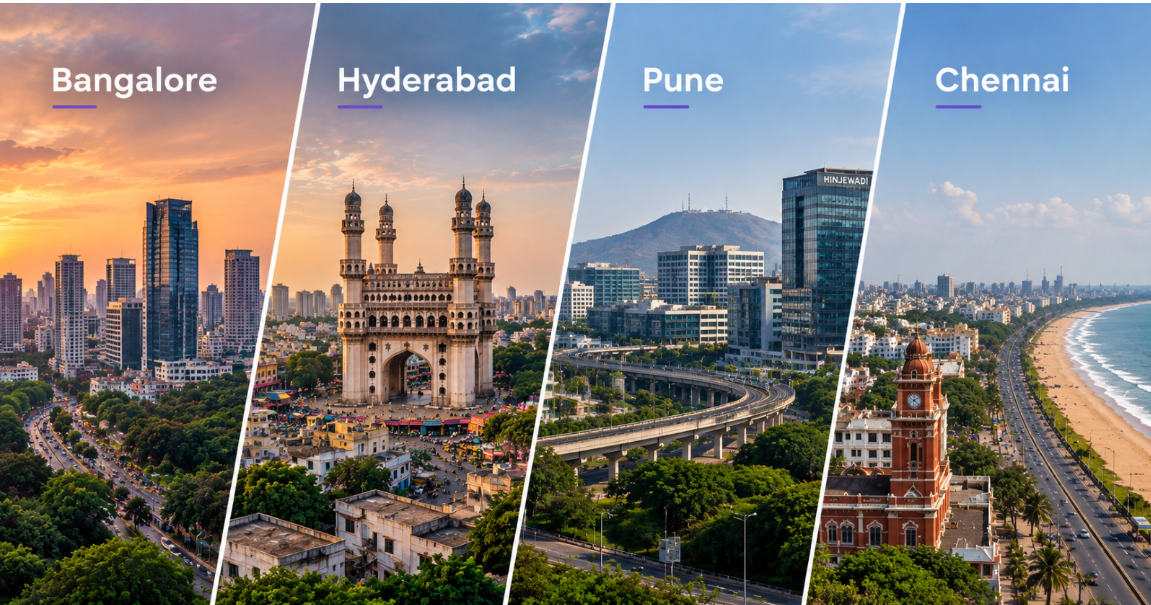
Global companies are increasingly looking beyond Bangalore and considering cities such as Hyderabad, Pune, Chennai, Delhi-NCR, and several emerging locations. The reason is simple: GCCs have changed. They are no longer built only to access lower-cost talent or provide back-office support. Many now handle product engineering, artificial intelligence, cybersecurity, research and development, finance, analytics, and other business-critical functions.
As the role of GCCs becomes more strategic, companies are looking more closely at what each city can offer.
The question is no longer simply, “Which city has the largest talent pool?”
It is, “Which city is the right fit for the capabilities we want to build?”
Why Are Companies Looking Beyond Bangalore?
Bangalore has one of the deepest technology talent pools in India, but that also means intense competition.
Established GCCs, technology companies, startups, and IT services firms are all hiring from the same market. Competition becomes even stronger for specialized professionals in areas such as artificial intelligence, cloud engineering, cybersecurity, data engineering, and product development.
For a company setting up a new centre, this can make hiring experienced professionals more challenging and expensive.
There is also the question of scale. A company may be able to build its first 100 or 200 employees in Bangalore, but expanding to several hundred or even thousands of employees require a much broader talent strategy.
This is one reason companies are looking at multiple locations rather than putting all their hiring into one city.
The shift does not mean Bangalore is becoming less relevant. Instead, companies now have more choices.
The Rise of a Multi-City GCC Strategy
A growing number of organisations are thinking about GCCs as a network rather than a single office.
For example, a company could build its product engineering team in Bangalore, establish analytics and finance capabilities in Pune, develop specialised technology teams in Hyderabad, and use Chennai for engineering or manufacturing-related functions.
Each location can play a different role.
This approach can help companies access different talent pools, reduce dependence on one market, and create more flexibility as their operations grow.
Colliers has highlighted this broader movement, with Bengaluru and Hyderabad continuing to lead GCC demand while cities such as Chennai, Pune, and other locations gain momentum.
For companies planning a GCC today, this means location strategy needs to be connected to the wider business strategy.
Why Hyderabad Is Attracting GCCs
Hyderabad has become one of the strongest alternatives to Bangalore for technology-led GCCs.
The city has developed a large ecosystem of multinational technology companies and offers talent across software engineering, cloud, data, cybersecurity, enterprise technology, and digital services.
Its established commercial infrastructure also makes it suitable for companies looking to build sizeable teams.
For technology organisations, Hyderabad can offer the combination of talent depth, ecosystem maturity, and room to scale that they need.
The city’s growth is reflected in GCC demand. Bengaluru and Hyderabad together have accounted for more than 60% of GCC leasing activity since 2021.
For companies that want to build significant technology capabilities without relying entirely on Bangalore, Hyderabad is becoming an increasingly important option.
Why Pune Continues to Gain Ground
Pune has a different advantage.
The city has a strong combination of technology, engineering, manufacturing, automotive, financial services, and enterprise talent. That makes it particularly useful for organisations whose GCC requirements extend beyond software development.
Pune can be a strong choice for companies looking for engineering professionals, enterprise technology specialists, finance teams, and people with industry-specific knowledge.
The city’s established technology corridors and engineering ecosystem also provide a strong foundation for long-term GCC growth.
For companies with manufacturing, engineering, technology, or financial services requirements, Pune can offer a talent mix that is difficult to replicate in a single location.
Chennai’s Growing GCC Opportunity
Chennai is another city gaining attention as GCCs become more specialised.
The city has a long-established manufacturing and engineering ecosystem, making it particularly relevant for automotive, industrial, engineering, and technology companies.
Chennai’s GCC activity has also grown significantly in recent years. Colliers reported that GCC leasing in the city in 2025 was more than four times its 2021 level.
This growth highlights an important point.
A GCC location does not always need to be the country’s biggest technology hub. For certain businesses, industry expertise can matter just as much as the overall size of the technology talent pool.
A manufacturing company may find greater value in an engineering-focused ecosystem than in choosing a city simply because it has the largest number of software professionals.
Emerging Cities Are Entering the Picture
The GCC expansion story is also moving beyond India’s traditional Tier-I cities.
Cities such as Coimbatore, Jaipur, Chandigarh, Ahmedabad, Kochi, Indore, and Bhubaneswar are increasingly being considered for selected technology and business functions.
Recent hiring trends show stronger technology hiring activity in Tier-II and Tier-III cities. Lower operating costs, improving infrastructure, access to local talent, and lower concentration of employers can make these locations attractive for specific types of teams.
However, lower cost should not be the only reason to choose an emerging city.
Companies need to ask whether the city has enough relevant talent, experienced managers, supporting infrastructure, and the ability to scale over several years.
A city that works for a 50-person team may not necessarily work for a 500-person centre.
Talent Is Becoming the Most Important Factor
Cost has always been part of the GCC conversation. Talent is now becoming just as important, if not more important.
India’s GCC ecosystem has moved well beyond traditional back-office work. According to the latest Nasscom-Zinnov data cited by Financial Express, India has more than 2,100 GCCs employing around 2.36 million professionals and generating approximately $98.4 billion in annual revenue.
These centres increasingly handle product development, artificial intelligence, research, cybersecurity, analytics, finance, and other strategic functions.
That requires a different kind of workforce.
Companies need experienced engineers, architects, data specialists, product managers, cybersecurity professionals, finance experts, and business leaders. They also need people who can work effectively with global teams and take ownership of important business functions.
This is why GCC talent in India is becoming a strategic consideration for companies planning their location strategy. The right city is not simply the one with the largest workforce. It is the one that offers access to the specific skills and experience the business needs.
Cost Matters, But It Is Not the Whole Story
It can be tempting to choose a location based mainly on salary levels or office costs.
That can be a mistake.
A city with lower salaries may not actually be cheaper if roles take months to fill, attrition is high, or senior professionals need to be relocated from another market.
Companies should look at the total cost of building and operating the GCC.
This includes:
- Talent acquisition
- Employee compensation
- Attrition and retention
- Office and infrastructure costs
- Leadership availability
- Recruitment timelines
- Training and development
- Business continuity
- Relocation requirements
- Long-term expansion
The goal should be cost efficiency without compromising the capabilities the GCC is expected to deliver.
Industry Specialization Is Becoming More Important
Different Indian cities have developed different areas of strength.
Bangalore and Hyderabad continue to be strong choices for technology and digital capabilities.
Pune offers a combination of technology, engineering, manufacturing, and financial services talent.
Chennai has a strong engineering and manufacturing ecosystem.
Delhi-NCR offers access to a large and diverse talent market, including technology, consulting, financial services, and business functions.
Emerging cities can provide specialised talent and additional capacity for companies that are willing to develop distributed teams.
This means GCC strategy should start with the capabilities a company wants to build and then identify the locations that best support those capabilities.
The city should follow the capability strategy, not the other way around.
From Location Selection to GCC Setup
Choosing the right city is only the first step.
Companies also need to think about how the centre will be launched, staffed, managed, and scaled.
A successful GCC setup in India requires more than finding office space and starting recruitment. Companies need to define the operating model, workforce plan, leadership structure, governance framework, technology requirements, and long-term growth strategy.
The hiring strategy should also be designed around the future organisation rather than just the first set of vacancies.
For example, a company building an AI and product engineering centre will have very different requirements from one establishing a finance and shared services centre.
The initial leadership team, hiring priorities, infrastructure, and location strategy should all reflect that difference.
Should Companies Build in One City or Several?
There is no universal answer.
A single-city model can work well when a company needs a highly concentrated team, close collaboration, or a specific talent ecosystem.
A multi-city model can make sense when an organisation wants access to different skill pools or wants to reduce dependence on a single labour market.
The right choice depends on the operating model.
Some companies may start with one primary GCC and add a smaller satellite location later. Others may deliberately distribute capabilities from the beginning.
What matters is that the decision is intentional.
What Should Companies Evaluate Before Choosing a City?
Before committing to a location, global companies should look at several factors.
Talent depth: Can the city provide the specialised skills the GCC needs today and in the future?
Leadership availability: Can the company find experienced managers and functional leaders locally?
Industry ecosystem: Are there companies, universities, vendors, and professional networks that support the required capabilities?
Scalability: Can the organisation grow from its initial team to a much larger workforce without creating significant hiring challenges?
Infrastructure: Does the city offer reliable office infrastructure, connectivity, transportation, and business continuity options?
Strategic fit: Does the location support the role the GCC is expected to play in the global organisation?
Looking at these factors together provides a much clearer picture than simply comparing salary levels between cities.
India’s GCC Market Is Becoming More Distributed
Bangalore is not disappearing from the GCC map.
It will continue to be one of India’s strongest technology and innovation hubs. Hyderabad, Pune, Chennai, and Delhi-NCR will also remain important, while emerging cities are likely to become increasingly relevant for specific capabilities.
What is changing is the way companies think about these locations.
The modern GCC is no longer just a delivery centre. It can be responsible for product development, AI, engineering, research, cybersecurity, analytics, finance, and strategic business functions. As a result, the best location is not necessarily the city with the biggest talent pool or the lowest operating cost.
It is the location that gives the company the right combination of talent, leadership, industry expertise, infrastructure, scalability, and long-term business value.
For global companies planning their next phase of India expansion, the question is therefore not simply, “Bangalore or somewhere else?”
The better question is: Which Indian talent ecosystem is best suited to the capabilities we want to build?
That shift in thinking is likely to shape the next phase of India’s GCC growth.